Preface Preface
These notes were developed by the first author in the process of teaching a course on applied numerical methods for Civil Engineering majors during 2002-2004. The course was modified to include Mechanical Engineering majors in 2005. The materials underwent a major revision by the second author in 2006-2007 and have been periodically updated since then. We are grateful to Yaqin Feng and Erik Boczko who have taught the course several times and made many suggestions that improved the notes. Thanks also go to numerous students who have pointed out typos and mistakes.
The goal of these lectures is to introduce concepts of numerical methods while simulataneously introducing programming principles using MATLAB.
In these lecture notes, MATLAB programming is interspersed with material on numerical methods. We have strived to make MATLAB instructions detailed and explicit, but not verbose. Often students are asked to write new programs based on working examples. The exercises grow in complexity as the students build their programming skills.
The material assumes only the topics covered in a typical Calculus I and II sequence, plus an understanding of differential equations at the level sometimes taught in Calculus II. The material on Linear Algebra starts from the beginning and was designed to be a quick introduction to the topic. The material on differential equations starts with Euler’s method culminates with an intro to Finite Elements. Overall, the student should leave the course with a very broad understanding of numerical methods.
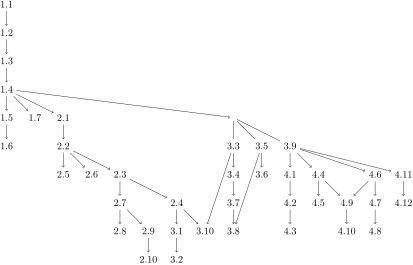
The lectures are intended to be used in a computer classroom with students working MATLAB examples during the lecture or with students reading the notes and working the examples after a brief introduction. At Ohio University we have had good success with this Lecture/Lab format. We ask students to complete all of the exercises in groups of 2-3 students and this accounts for a significant portion of the grade (e.g. 30%.). Typically we will give an exam covering each of the first three chapters and a comprehensive final exam. We have sometimes employed student projects in addition to or instead of exams. We typically cover all sections except 2.10, covering one section per class meeting. For those who want or need to eliminate some sections, we show the dependencies between sections below.
Todd Young and Martin Mohlenkamp
June 2026

