Section2.8An Application of Eigenvectors: Vibrational Modes and Frequencies
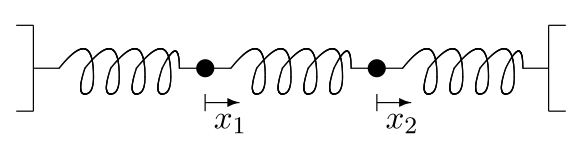
One application of eigenvalues and eigenvectors is in the analysis of vibration problems. A simple nontrivial vibration problem is the motion of two objects with equal masses \(m\) attached to each other and fixed outer walls by equal springs with spring constants \(k\text{,}\) as shown in Figure 2.8.1.
Let \(x_{1}\) denote the displacement of the first mass and \(x_{2}\) the displacement of the second, and note the displacement of the walls is zero. Each mass experiences forces from the adjacent springs proportional to the stretch or compression of the spring. Ignoring any friction, Newton’s law of motion \(ma = F\text{,}\) leads to
\begin{equation*}
\begin{array}{rlcclrrl}m \ddot{x}_1 &= -k(x_1-0)&+k(x_2-x_1)& &=& -2k x_1 &+ k x_2 &\text{and}\\ m \ddot{x}_2 &= &-k(x_2-x_1)&+k(0-x_2) &=& k x_1 &- 2 k x_2&\\\end{array}\text{.}
\end{equation*}
Dividing both sides by \(m\) we can write these equations in matrix form
\begin{equation}
\ddot{\xb}= - A \xb\text{,}\tag{2.8.1}
\end{equation}
For this type of equation, the general solution is
\begin{equation*}
\xb(t) = c_{1} \vb_{1} \sin\left(\sqrt{\lambda_{1}}\; t + \phi_{1}\right) + c_{2} \vb_{2} \sin\left(\sqrt{\lambda_{2}}\; t + \phi_{2}\right)
\end{equation*}
where \(\lambda_{1}\) and \(\lambda_{2}\) are eigenvalues of \(A\) with corresponding eigenvectors \(\vb_{1}\) and \(\vb_{2}\text{.}\) One can check that this is a solution by substituting it into the equation (2.8.1).
The eigenvalues of \(A\) are the squares of the frequencies of oscillation. Let’s set \(m =1\) and \(k=1\) in \(A\text{.}\) We can find the eigenvalues and eigenvectors of \(A\) using MATLAB:
>> A = [2 -1 ; -1 2]
>> [v e] = eig(A)
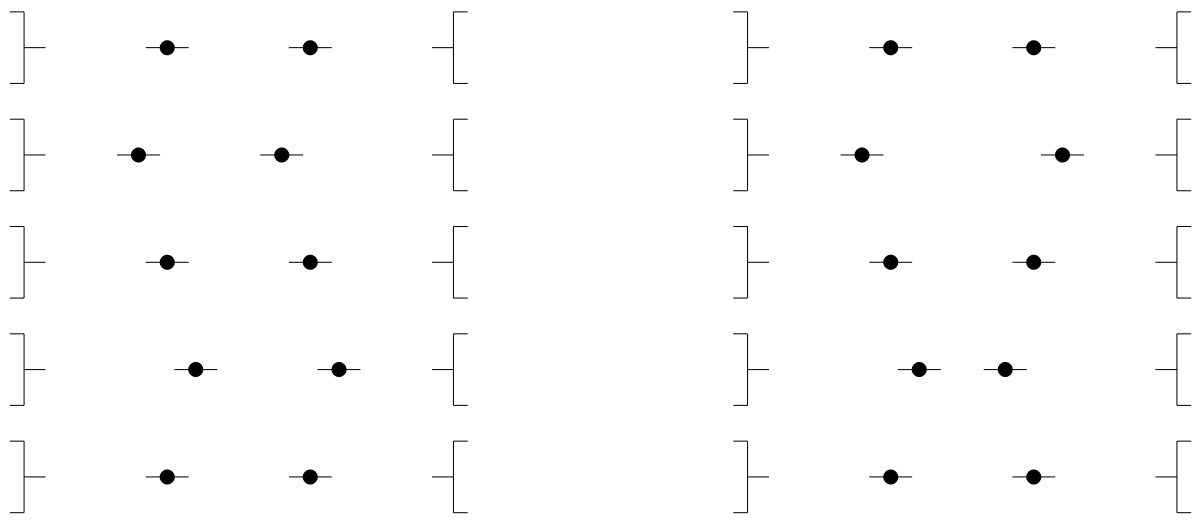
This should produce a matrix v whose columns are the eigenvectors of \(A\) and a diagonal matrix \(e\) whose entries are the eigenvalues of \(A\text{.}\) In the first eigenvector, \(\vb_{1}\text{,}\) the two entries are equal. This represents the mode of oscillation where the two masses move in sync with each other. The second eigenvector, \(\vb_{2}\text{,}\) has the same entries but opposite signs. This represents the mode where the two masses oscillate in anti-synchronization. See Figure 2.8.2. Notice that the frequency for anti-sync motion is \(\sqrt{3}\) times that of synchronous motion.
Figure2.8.2.Two vibrational modes of a simple oscillating system. In the left mode the weights move together and in the right mode they move opposite. Note that the two modes actually move at different speeds.
Which of the two modes is the most dangerous for a structure or machine? It is the one with the lowest frequency because that mode can have the largest displacement. Sometimes this mode is called the fundamental mode.
Find the modes and their frequencies for 4 equal masses with \(m=3\) kg and equal springs with \(k=10\) N/m. Describe the modes (a sketch will suffice).
Find the modes and their frequencies for three unequal masses \(m_{1} = 2\) kg, \(m_{2} = 3\) kg and \(m_{3} = 4\) kg connected by 4 equal springs with \(k = 5\) N/m. How do unequal masses affect the modes? (You must start with the equations of motion to do this correctly.)